This document was prepared by Jim Martin duirng his time as Ombudsman, and thus it 's position in the menu.
It cannot really be said to be either a plan, nor to include objectives. It is more a statement of status.
Ombudsman’s foreword
A track record of achievement
Over the past five years, I believe SPSO has transformed not only how we deliver our service, but also the complaints handling landscape and culture in Scotland. I am very grateful to SPSO staff for their expertise and hard work in bringing these achievements about against a background of reducing or static resources and rising complaint volumes and complexity. I am also grateful to the many external people and organisations who have worked in partnership with us to improve the standards of complaints handling across the public sector.
My term of office will come to an end in April 2017. I want to hand over anorganisation that has the flexibility to manage the challenges the SPSO will face. The strategic plan presented here, which we consulted on at the end of 2015, builds on the work we have done to vastly improve our business efficiency and to set up internationally-recognised model complaints handling procedures throughout the public sector. It looks ahead to the new areas of reviews and complaints that will come to SPSO over the next four years, and includes further initiatives we are planning to help public authorities learn from complaints so that repeat failings are prevented and there is measurable improvement in public services.
Caseload demands
SPSO’s single greatest challenge is to manage the volume of complaints we receive and their increasing complexity. While the rise in demand for our service is in many ways to be welcomed (it demonstrates the public’s response to increased clarity about how to report problems with a view to improving public services), we must be adequately resourced.
I believe we have maximised any major business efficiencies we can with our
existing resource base through the many initiatives we have implemented.
Therefore, if demand and complexity continue to grow and additional investigations resources are not forthcoming, we will need to consider measures to manage the volume and complexity of cases. These may include taking longer to consider cases and introducing further criteria under a ‘proportionality’ or ‘significance’ test, to reduce the number of cases we consider.
New areas of jurisdiction
Over the past five years, our remit has expanded to include prisons, water providers
and prisoner health, contributing considerable savings to the public purse. This
expansion will continue over the period of the next strategic plan. Key additions are:
- the review of Scottish Welfare Fund decisions from April 2016
- complaints about the Named Person and Child’s Plan from August 2016
- health and social care integration complaints handling arrangements including responsibility for social work complaints from April 2017
New areas of work are resourced separately from existing funding arrangements.
Resourcing levels for these and other new responsibilities will need to be monitored and managed separately so that shifts in demand can be resourced effectively. As we grow, we will seek to integrate these and other new areas into the organisation in a way that leads to the most effective delivery of all of our strategic objectives.
Learning and improvement
We already follow up our recommendations robustly with authorities on a complaint-by-complaint basis, requiring specific evidence that authorities have taken the action that we have asked them to. With around 1,500 recommendations made each year, this represents a considerable contribution to public service improvement, but we, and other stakeholders, want to be reassured that the outcomes for the public are as far-reaching as possible.
We plan to set up a small pilot unit to support authorities to take action to learn from complaints effectively and to implement improvements that prevent repeat service failings and address any systemic issues identified by our decisions. The unit will work with authorities to ensure that our findings and recommendations result in measureable improvement actions. This will benefit both the public and authorities and, over time, should reduce complaints to SPSO about those service failings that the unit addresses.
Other challenges and opportunities
While we can anticipate some of the changes in the Scottish public sector over the next four years, we cannot of course predict every development that will impact on our business. The Scottish Government is continuing its strategy for implementation of the recommendations of the Crerar Review and Sinclair Report to make it simpler and easier for people to complain. While taking on responsibility for additional new areas is very much in line with this simplification agenda, these will present challenges for SPSO. We must also be prepared for the potential impact of technological developments affecting how people access complaints procedures, and changes in the consumer and ombudsman landscape in the rest of the UK.
I am grateful to the people and organisations that took the time to comment on our draft strategic plan. Their input will help guide and shape SPSO, and enable us to deliver a continually improving ombudsman service for the people of Scotland.
Strategic objectives and equalities commitments 2016-2020
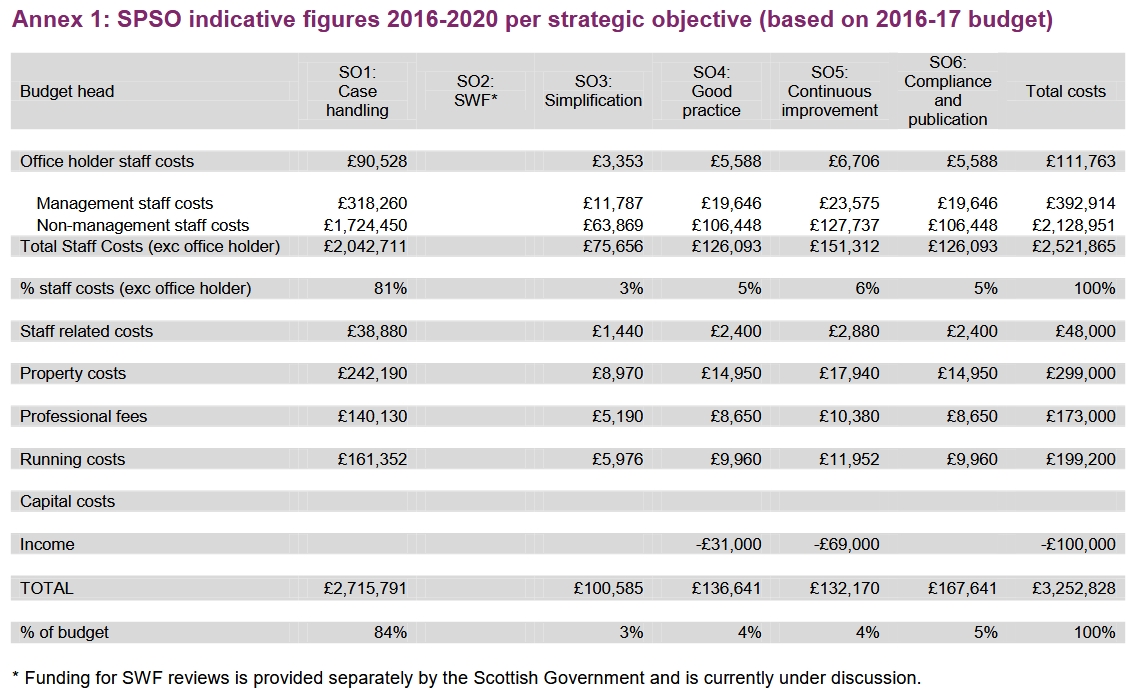
This strategic plan builds on our previous plan for 2012-2016. It lays out our high level objectives and equalities commitments, which are largely determined by our statutory duties. The timetable for achieving the plan is the four years to 2020, and it is supported by detailed annual operational plans underpinned by a raft of measures1 that monitor our performance against targets and help us improve our service. The cost of delivering the plan is outlined in the budget section and the annex contains indicative figures per strategic objective.
Strategic objectives
- To provide a high quality, user-focussed independent complaints handling service - by developing our capacity as complaints handlers to be able to deliver individual benefit to our customers; by being accessible and dealing with all enquiries and complaints impartially, consistently, effectively, proportionately and in a timely manner; and by producing clear, accurate and influential decisions about complaints.
- To provide a high quality, user-focussed independent review service for Scottish Welfare Fund decisions - by developing our capacity to manage reviews for the benefit of both applicants and local authorities by being accessible and dealing with all enquiries and applications impartially, consistently, effectively, proportionately and in a timely manner; and by producing clear, accurate and influential information about the outcomes of reviews.
- To simplify the design and operation of the complaints handling system in Scottish public services - by working in partnership with service providers, regulators and other key stakeholders to facilitate the development of and compliance with simplified, standardised and user-focussed Complaints Handling Procedures across the public sector as an integral part of the wider administrativejustice system in Scotland.
- To improve complaints handling by public service providers - by using our expertise and resources to monitor, promote and facilitate the sharing of best practice and support service providers in improving their complaints handling.
- To be an accountable, best value organisation - by making best use of our resources and demonstrating continuous improvement in our operational efficiency and supporting the professional development of our staff.
- To support public service learning and improvement - by continuing to raise informed awareness of SPSO’s role; by supporting public service providers to improve outcomes for the public through their learning from SPSO enquiries, decisions and recommendations; and by working in partnership with public service providers, policy makers, scrutiny bodies and regulators to further those improvements.
Note: To see our annual business plans summarising performance against measures, risk appetite and so on, visit www.spso.org.uk/business-plans.
Noted that this link no longer leads to where it indicates !
Equalities commitments
- To take proactive steps to identify and reduce potential barriers to ensure that our service is accessible to all.
- To identify common equality issues (explicit and implicit) within complaints or reviews brought to our office and feed back learning from such cases to all stakeholders.
- To ensure that we inform people who are taking forward a complaint or review of their rights and of any available support, and that we encourage public authorities to do the same.
- To ensure that we play our part in ensuring that service providers understand their duties to promote equality within their complaints handling and review procedures.
- To monitor the diversity of our workforce and supply chain, and take positive steps where under-representation exists.
Running the business
Our main accountability and governance mechanisms are:
- the SPSO Audit and Advisory Committee
- internal auditors (the Scottish Legal Aid Board) who look at areas such as HR, payroll, IT systems installation and document management
- feedback from our three sounding boards (customers, local government and NHS)
- evidence sessions to Scottish Parliament committees
- budget discussions with the Scottish Parliamentary Corporate Body (SPCB)
- feedback from our service users
- staff surveys.
To ensure that we are able to meet and monitor our commitments, we regularly carry out risk assessments and share these findings with our Audit and Advisory Committee and review our risk management practices as part of our cyclical internal audit programme.
Continuous improvement
We have a holistic approach to continuous improvement and use a range of recognised organisational improvement tools and feedback mechanisms including:
- the Public Service Improvement Framework (PSIF) model - this is a self- assessment approach which encourages organisations to conduct regular
comprehensive reviews of their own activities and results - professional service standards - developed in conjunction with our own customer sounding board, and other UK and Irish ombudsman schemes, to reflect the core values and standards of a modern ombudsman service and to provide a clear framework on which to base quality assurance activities
- performance indicators
- our procedures for customer complaints about our service
- the Investors in People Standard (IIP)
- a comprehensive learning and development training programme
- an independent business process review to develop the efficiency and effectiveness of our case handling process
- external audit through Audit Scotland
- active participation and contribution to the sharing of best practice between other ombudsman services within the UK, Ireland and internationally.
Budget
We operate against an annual cash-based budget that is reviewed by the SPCB and approved by the Scottish Parliament. The budget process historically has operated on the assumption of a zero-based budget and has therefore required real-term cuts on an annual basis. During the 2012-2016 strategic plan period, we completed a programme of 15% cuts. These cuts were in addition to the circa £1.5 million of savings made to the public purse by SPSO taking on responsibility for prison, prisoner health and water sector complaints. We do not carry a contingency fund but instead have access to contingency arrangements through the Scottish Parliament where required.
The budget for 2016-17 is £3,253,0002, excluding costs associated with the new function for Scottish Welfare Fund reviews, which is currently provided separately by the Scottish Government. The budget does not reflect funding for any other potential new areas of work nor for a review of accommodation requirements.
The indicative figures for 2017-18, which have been provided to the SPCB as part of the 2015-16 budget process, assume a continuation of the 2016-17 functions but do not reflect any further changes to our remit.
Timetable
Five of the six strategic objectives set out in this strategic plan reflect our current statutory obligations and the related core functions to be delivered by the SPSO over the four-year period up to March 2020. The sixth (strategic objective 2) reflects the new additional responsibility for SWF reviews. At this stage, there are no anticipated significant variations in areas of spend for core business areas year-on-year.
Indicative Costs
Indicative figures for of the delivery of each of the strategic objectives of the strategic plan are set out in Annex 1, on the assumption that the SPSO’s legal duties and strategic objectives can be achieved with the resources set at the level reflected in the 2016-17 budget. These indicative figures would potentially be impacted on by rising demand for service, or additional jurisdictional or legal responsibilities. These estimates do not include contingencies, for example for legal challenges.
Approximately 84% of SPSO resources are already fully dedicated to delivering strategic objective 1. The split of resources across the strategic objectives may need to be realigned further within the four-year period of the strategic plan to reflect any further increases in demand to this aspect of the service. As set out above, further additions or extensions to the SPSO remit within this period would also require an additional review of our resource management.
This figure does not include additional fixed-term funding for a pilot learning and improvement unit.
Recruitment and accommodation
As our service expands to include SWF and social work complaints, it is possible that we will have to move premises or find other ways to accommodate additional staff since there is limited room to house additional staff in our current office. At a time of tight budgets, we do not intend to over-resource and will work with the Scottish Government and the SPCB to decide what is reasonable. However, uncertainty over SWF numbers, the impact of health and social integration complaints including social work and complaints about the Named Person function clearly presents a challenge to our business. If further additional areas of work are added to our remit, there may be a need to increase staff numbers and to review our accommodation requirements.
Click to see: Annex 1: SPSO indicative figures 2016-2020 per strategic objective (based on 2016-17 budget)